What Really Happens in a Stall: The Critical Angle of Attack Explained
Oct 19, 2026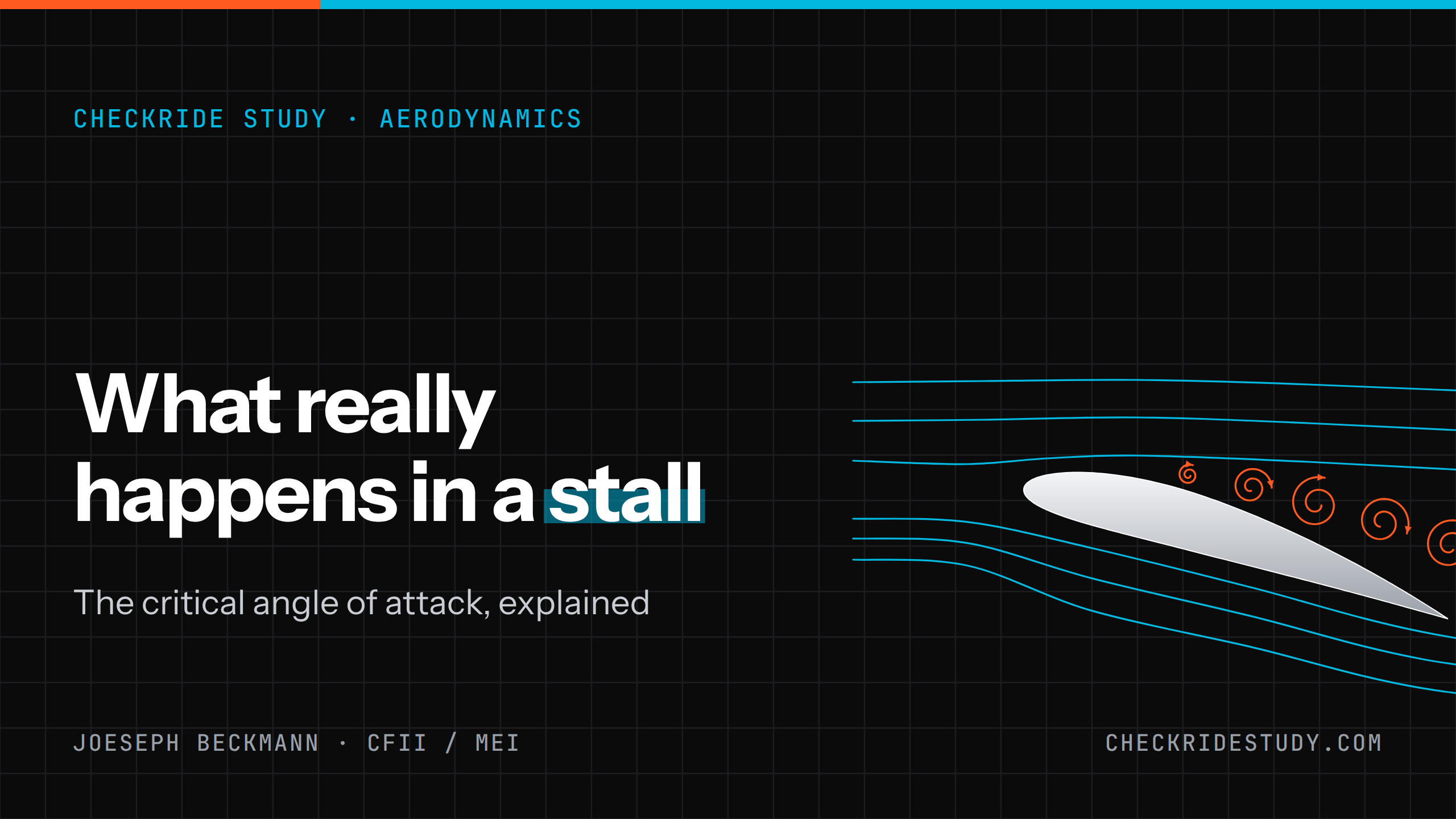
A stall happens when the wing exceeds its critical angle of attack. The air can no longer follow the top of the wing, so it separates and the wing loses lift. It has nothing to do with the engine, and it can happen at any airspeed.
Lift and Angle of Attack
The FAA defines angle of attack as the acute angle between the chord line of the airfoil and the direction of the relative wind. The chord line is an imaginary straight line drawn through the wing from the leading edge to the trailing edge. The relative wind is the direction of the airflow with respect to the wing, and it moves parallel to and opposite the airplane's flight path.
As you raise the nose and increase the angle of attack, the wing produces more lift, up to a point. That point is called the critical angle of attack. Every wing has one, and the exact number depends on the wing's design.
What Happens Past the Critical Angle of Attack
At normal angles of attack, the air flows smoothly over the top of the wing and follows its curved upper surface. That smooth, attached airflow is what makes lift.
Once the wing exceeds the critical angle of attack, the air can no longer follow the upper surface. It separates from the wing and breaks into turbulent, swirling air. The wing loses lift rapidly, and drag increases. That is a stall.
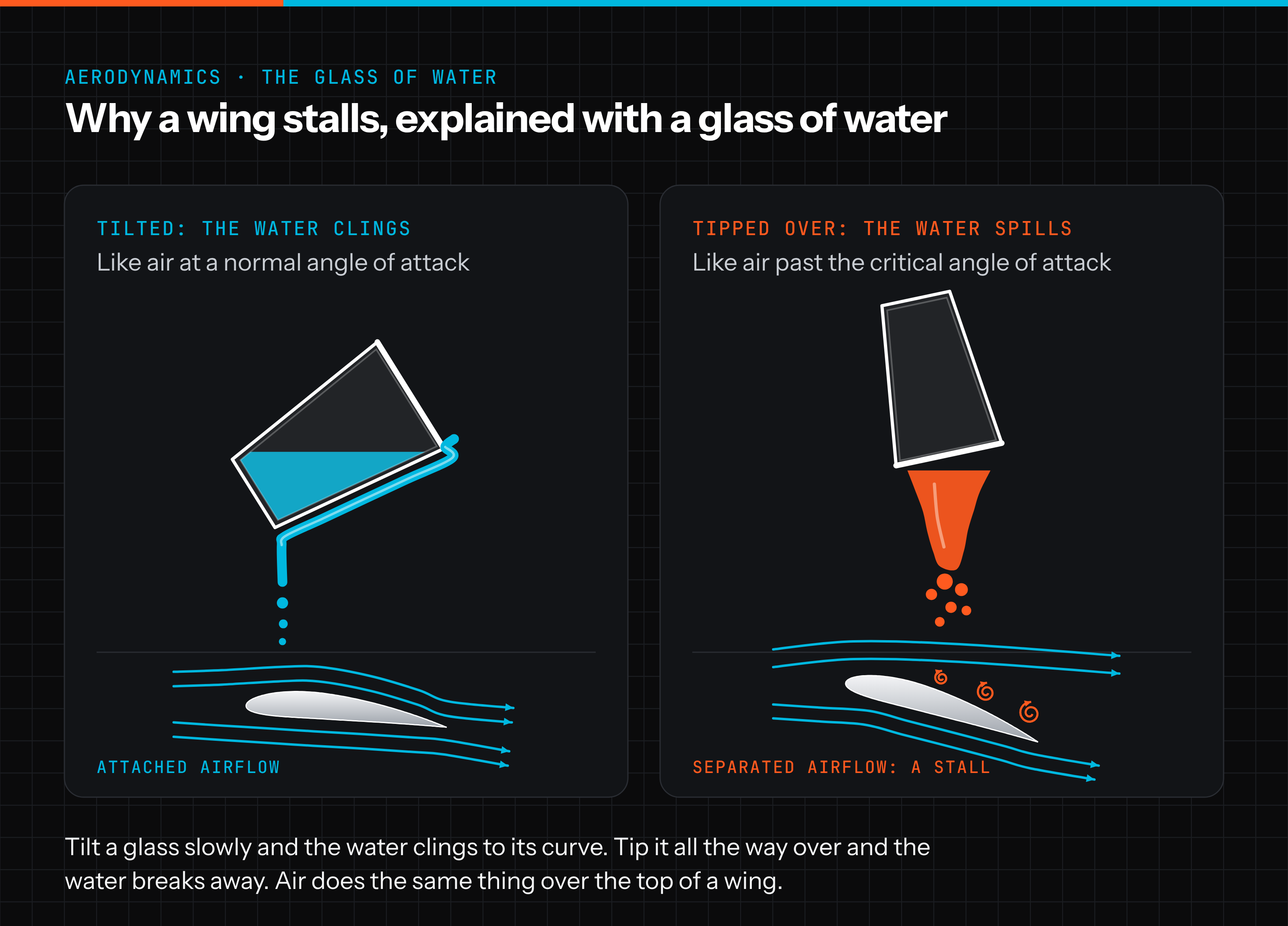
Here's how I explain it to my students. Picture tilting a glass of water to pour it. At first, the water clings to the side of the glass and follows its curve as it pours out. That's the air over the top of your wing at a normal angle of attack. It sticks to the curved upper surface and follows it all the way back.
Now tip the glass all the way over. The water can't follow the side of the glass anymore. It breaks away and spills straight out. That's a stall. Past the critical angle of attack, the air can no longer follow the curve of the wing, so it breaks away from the upper surface, and the lift it was creating goes with it.
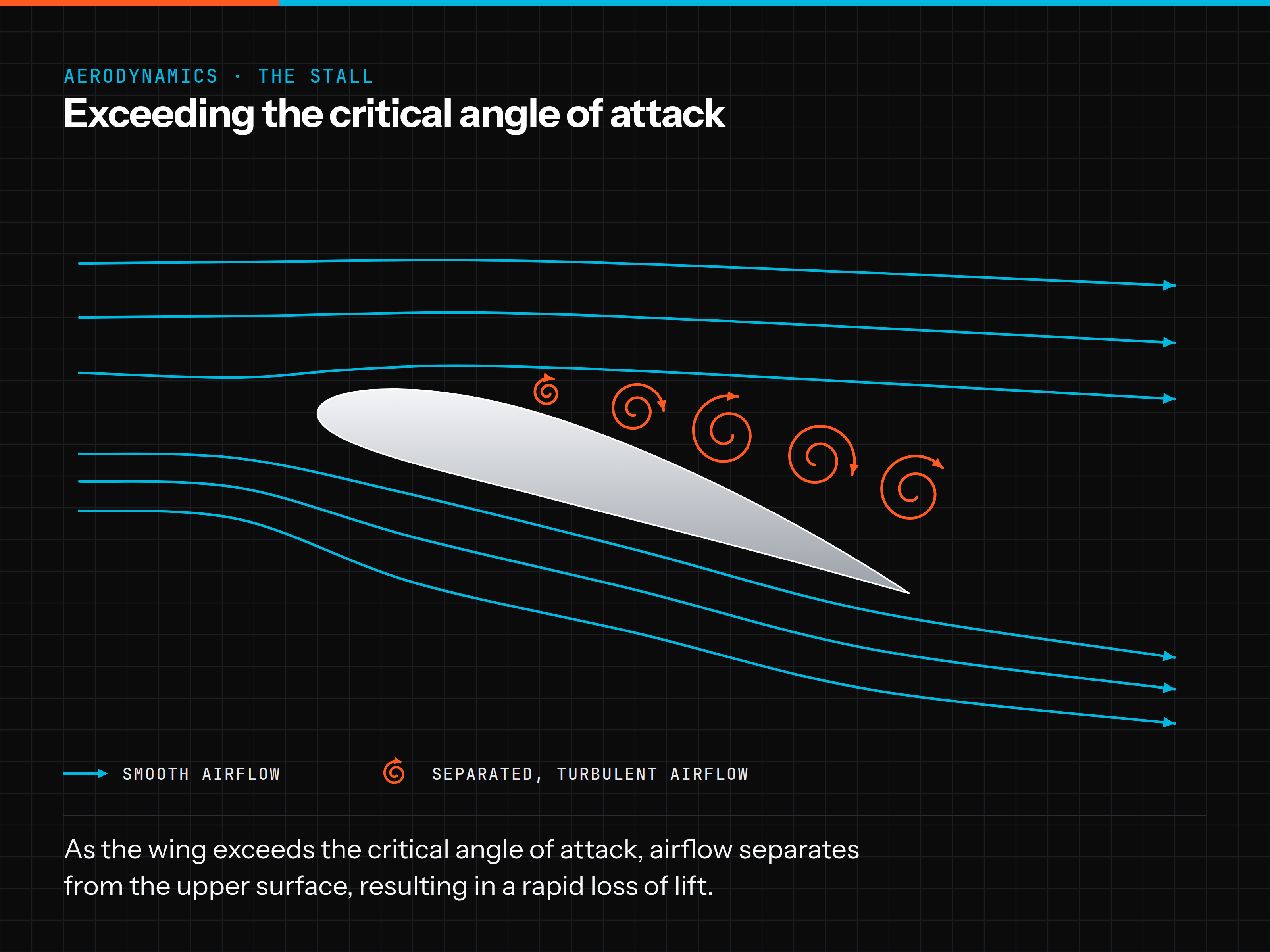
In the illustration above, the cyan lines show the air still flowing smoothly under the wing and around the leading edge. The orange swirls show the separated, turbulent air over the upper surface, which is no longer producing the lift the wing needs.
A Stall Is About Angle of Attack, Not Airspeed
Here's what your DPE wants to hear: an airplane can stall at any airspeed, in any flight attitude, and at any power setting.
Many students believe an airplane only stalls when it gets too slow. Slow flight does make a stall more likely, because you need a higher angle of attack to keep producing lift at low airspeed. But the stall itself happens because the wing exceeded its critical angle of attack, not because the airspeed dropped below a certain number.
That's why the stall speed in your POH isn't fixed. A heavier airplane needs more lift, so it stalls at a higher airspeed. In a steep turn or a sharp pull-up, the wing has to support more than the airplane's weight, which raises the stall speed too. That's how an airplane can stall well above its published stall speed. Extending flaps lowers the stall speed, and a forward center of gravity raises it.
How to Recognize a Stall Coming
The FAA teaches pilots to recognize a stall using sight, sound, and feel, before the stall fully develops.
The stall warning horn or light comes on as you approach the critical angle of attack. You'll feel buffeting as the separated airflow shakes the airframe and the controls. The controls get mushy and less responsive, because less air is flowing over them. In a power-on stall, you'll also see a high nose attitude with the airspeed decreasing.
When you feel these signs in training, that's the airplane telling you the wing is running out of lift.
How to Recover
The FAA's stall recovery comes down to one idea: reduce the angle of attack first. Everything else follows from that.
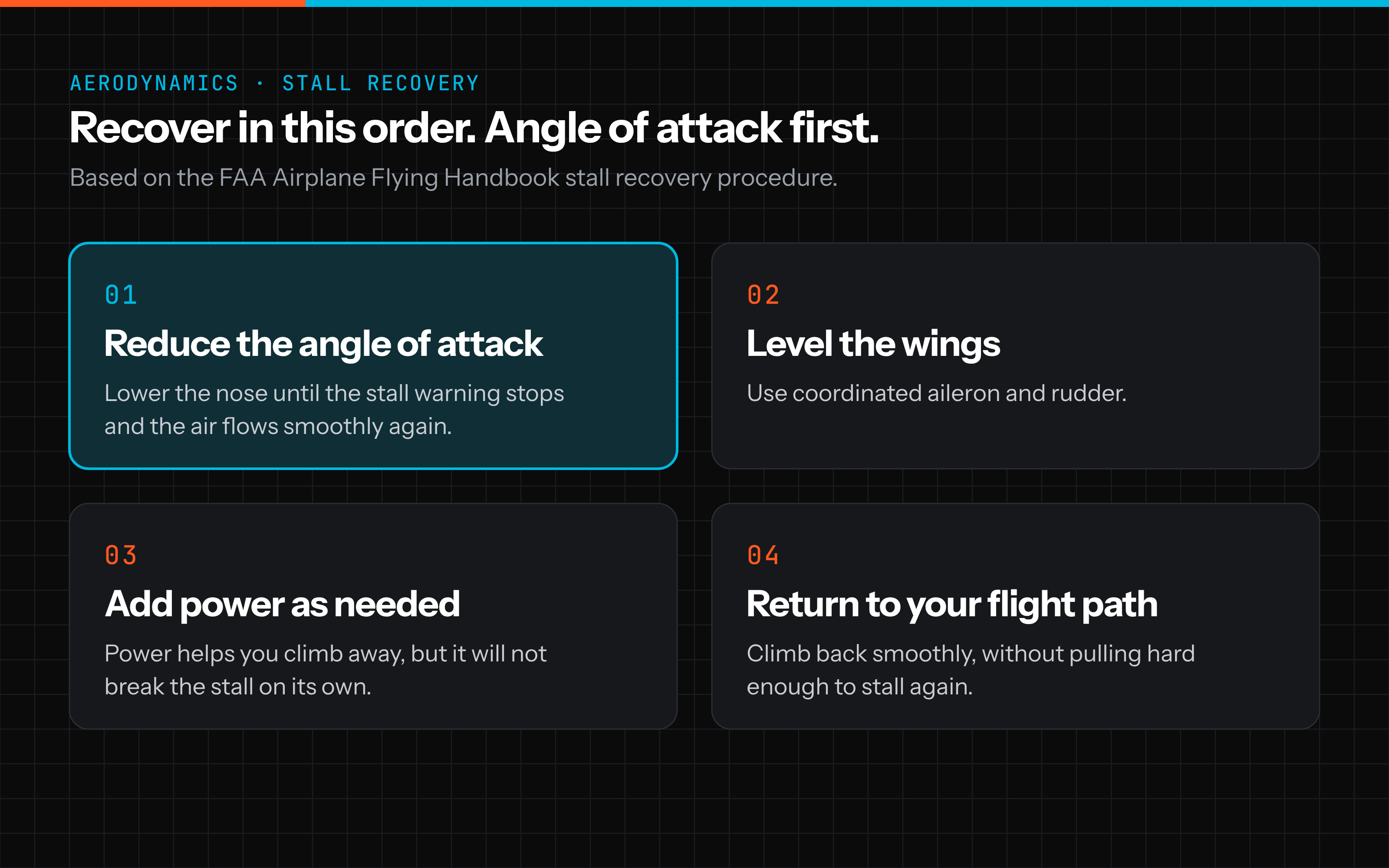
- Reduce the angle of attack. Lower the nose by releasing back pressure or applying forward pressure on the yoke until the stall warning goes away. This lets the air flow smoothly over the wing again.
- Level the wings using coordinated aileron and rudder.
- Add power as needed.
- Return to the desired flight path without pulling so hard that you stall again.
Notice that adding power is not the first step. Power alone won't break a stall if the wing is still beyond its critical angle of attack. The wing only starts flying again when you reduce the angle of attack. Think back to the glass of water: once it has spilled, you have to tilt the glass back before the water will follow the side again.
Where Stalls Happen in Real Flying
Most stall accidents don't happen at altitude during practice. They happen close to the ground, when a pilot is distracted or trying to fix a mistake.
The classic one is the base to final turn. A pilot overshoots the runway centerline and adds too much rudder to tighten the turn while holding the bank shallow. That uncoordinated, skidding turn at low altitude can lead to a stall, and if one wing stalls before the other, a spin.
The other is departure. Pitching up too steeply after takeoff, especially in a heavy airplane or on a hot day, can push the wing past its critical angle of attack at low altitude.
This is why we practice stalls during training, so you recognize the warning signs early and recover by instinct.
What to Expect on Your Checkride
The Private Pilot Airman Certification Standards include both power-off stalls, which simulate a stall during approach and landing, and power-on stalls, which simulate a stall during takeoff and departure. Your examiner will ask you to perform both, and to recognize and recover promptly.
On the oral portion, your examiner will want to know you understand why a stall happens, not just how to recover from one. Test yourself with the quiz below, and say each answer out loud before you pick it.
STALL QUIZ
Test yourself before your checkride
8 questions. Pick an answer to see the explanation.QUESTION 1 OF 8
What causes a stall?
A stall happens when the wing exceeds its critical angle of attack. The airflow separates from the upper surface and the wing loses lift, at any airspeed, attitude, or power setting.
QUESTION 2 OF 8
Can an airplane stall above its published stall speed?
A stall depends on angle of attack, not airspeed. In a steep turn or an abrupt pull-up, the load factor increases, and the wing can reach its critical angle of attack well above the published stall speed.
QUESTION 3 OF 8
In a level 60 degree banked turn, what are the load factor and the change in stall speed?
At a 60 degree bank in level flight, the load factor is 2 G's. Stall speed increases with the square root of the load factor, so it rises by about 41 percent.
QUESTION 4 OF 8
Which of these lowers the stall speed?
Extending flaps lowers the stall speed. A heavier airplane, a steeper bank, and a forward CG all raise it.
QUESTION 5 OF 8
What is the first step in stall recovery?
Reduce the angle of attack first. The wing stalled because it exceeded the critical angle of attack, so it only starts flying again when you lower the nose. Power alone will not break the stall.
QUESTION 6 OF 8
What phase of flight does a power-off stall simulate?
A power-off stall simulates a stall during approach and landing, with the airplane in the landing configuration and the power reduced. A power-on stall simulates takeoff and departure climb.
QUESTION 7 OF 8
What two things must happen for an airplane to enter a spin?
The airplane must be stalled, and there must be yaw. That is why staying coordinated, especially in the base to final turn, is so important.
QUESTION 8 OF 8
How does an aft center of gravity affect stalls?
An aft CG lowers the stall speed, but it makes stall and spin recovery more difficult. A forward CG raises the stall speed.
YOUR SCORE