
Turning Tendencies, Adverse Yaw, and Stability: What Your DPE Wants to Hear
Oct 27, 2026
The aerodynamics topics student pilots struggle with most on the checkride are left turning tendencies, adverse yaw, and stability. Left turning tendencies come from four forces created by the engine and propeller: torque, spiraling slipstream, P-factor, and gyroscopic precession. Adverse yaw is the nose swinging away from the turn because the rising wing makes more drag. Stability describes what the airplane does after it is disturbed. Static stability is its initial tendency, and dynamic stability is what it does over time.
Your DPE will not just ask you to define these. They will ask why you need right rudder on takeoff, why the nose swings the wrong way when you roll into a turn, and what your airplane does when turbulence bumps it. Here is how to explain each one.
1. Left turning tendencies
In most single engine training airplanes, the propeller turns clockwise when viewed from the pilot's seat. That rotation creates four forces that all push the nose to the left. They are strongest when you are at high power, low airspeed, and a high angle of attack, which is exactly what happens on takeoff and in the climb. That is why you need right rudder.
Torque
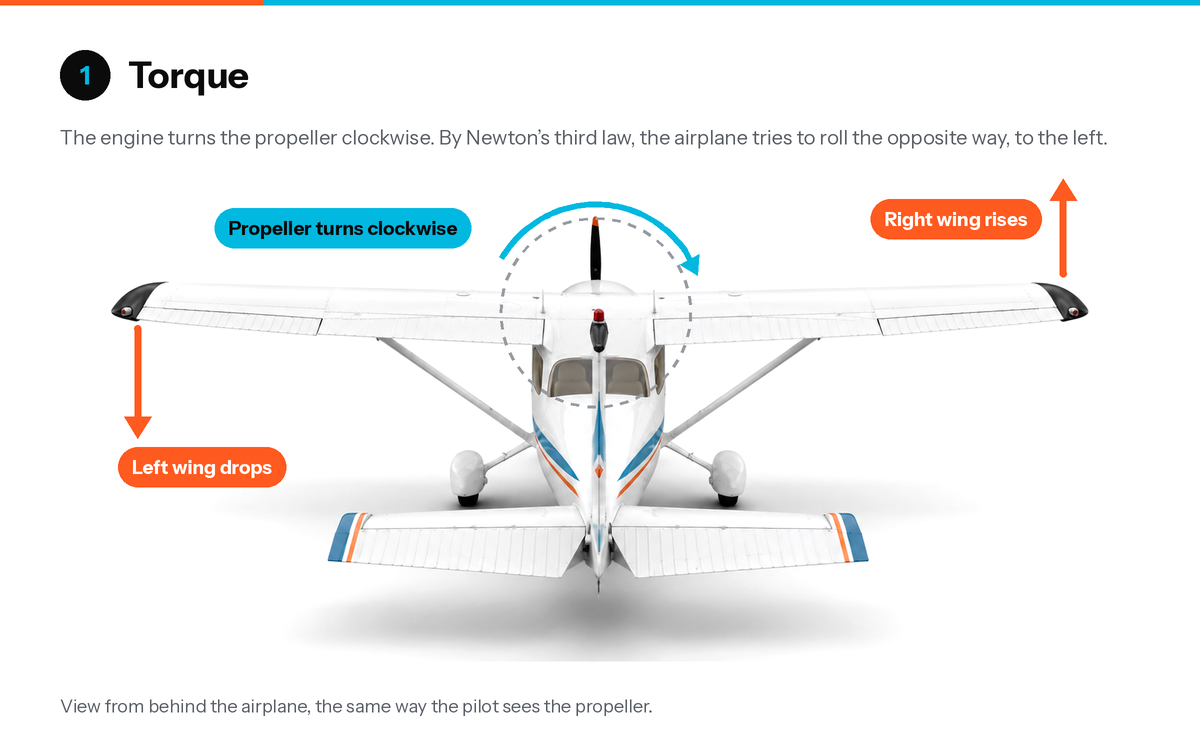
Torque comes from Newton's third law. For every action there is an equal and opposite reaction. As the engine spins the propeller clockwise, the airplane tries to roll the opposite way, to the left. On the takeoff roll, that roll pushes the left tire harder into the runway, which adds friction on that side and yaws the nose to the left.
Spiraling slipstream
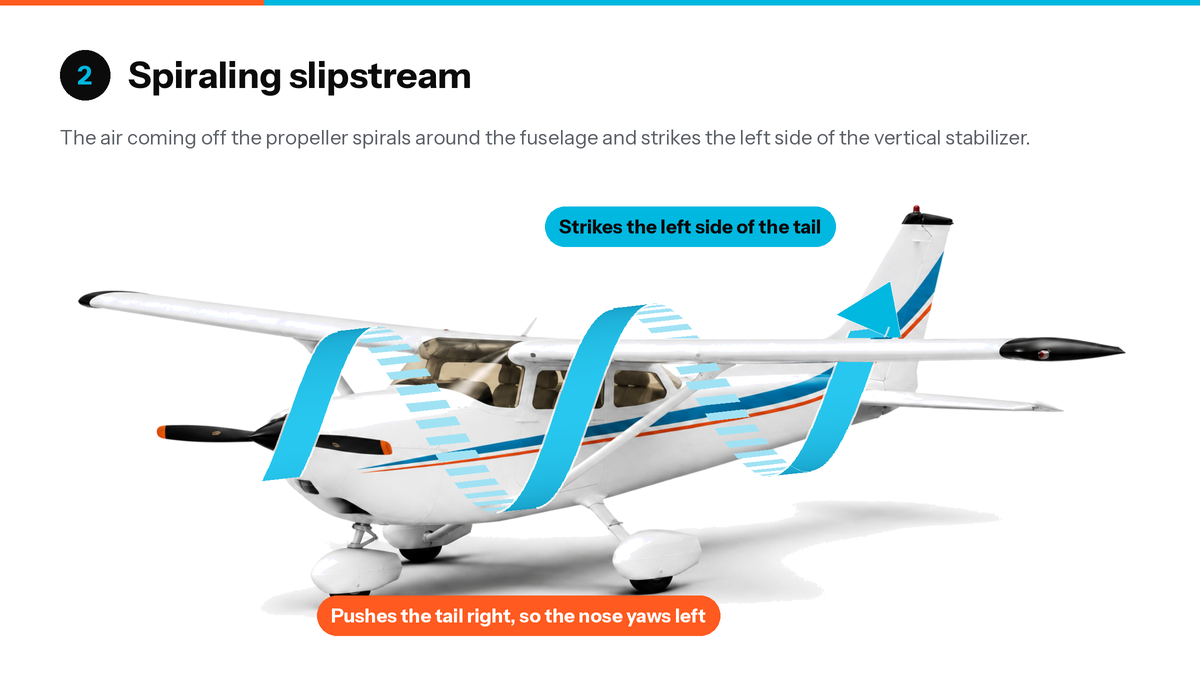
The air coming off the propeller does not flow straight back. It spirals around the fuselage and strikes the left side of the vertical stabilizer. That push on the left side of the tail yaws the nose to the left. It is strongest at high power and low airspeed, when the spiral is tight. At higher airspeeds the spiral stretches out and has less effect.
P-factor
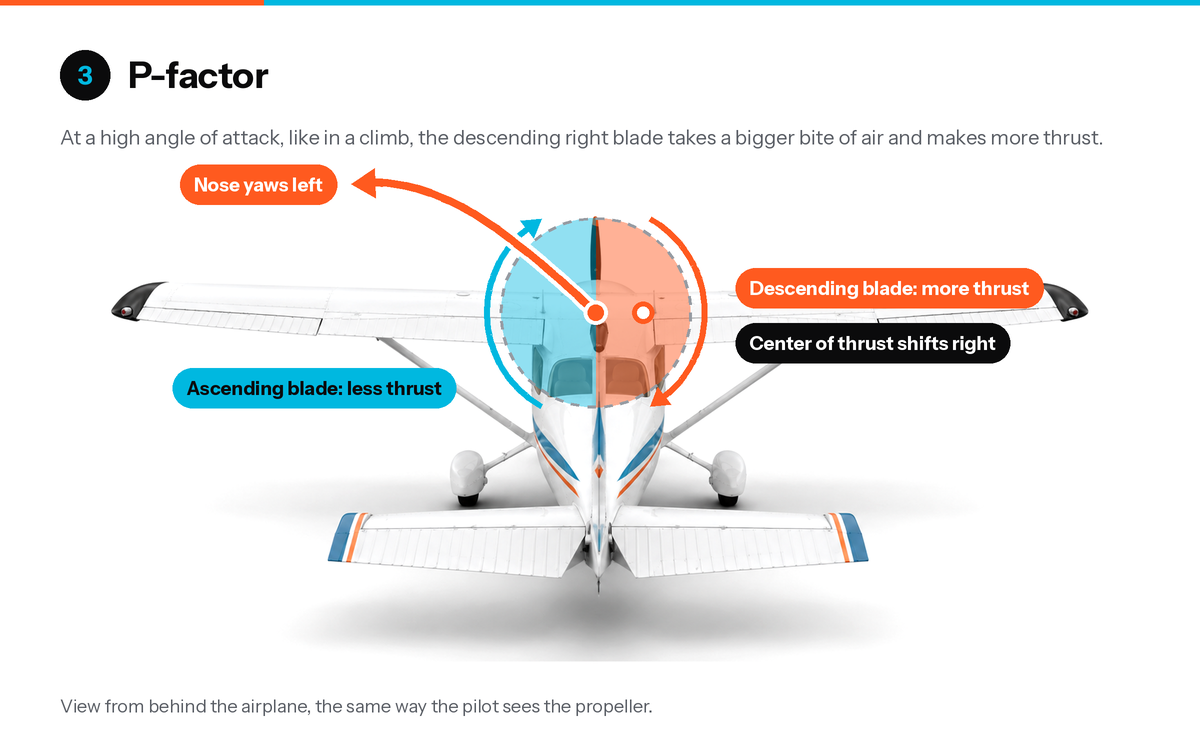
P-factor is also called asymmetric loading. When the airplane is at a high angle of attack, like in a climb, the descending blade on the right side meets the relative wind at a greater angle of attack than the ascending blade on the left side. The descending blade makes more thrust, so the center of thrust shifts to the right. More thrust on the right side yaws the nose to the left.
Gyroscopic precession
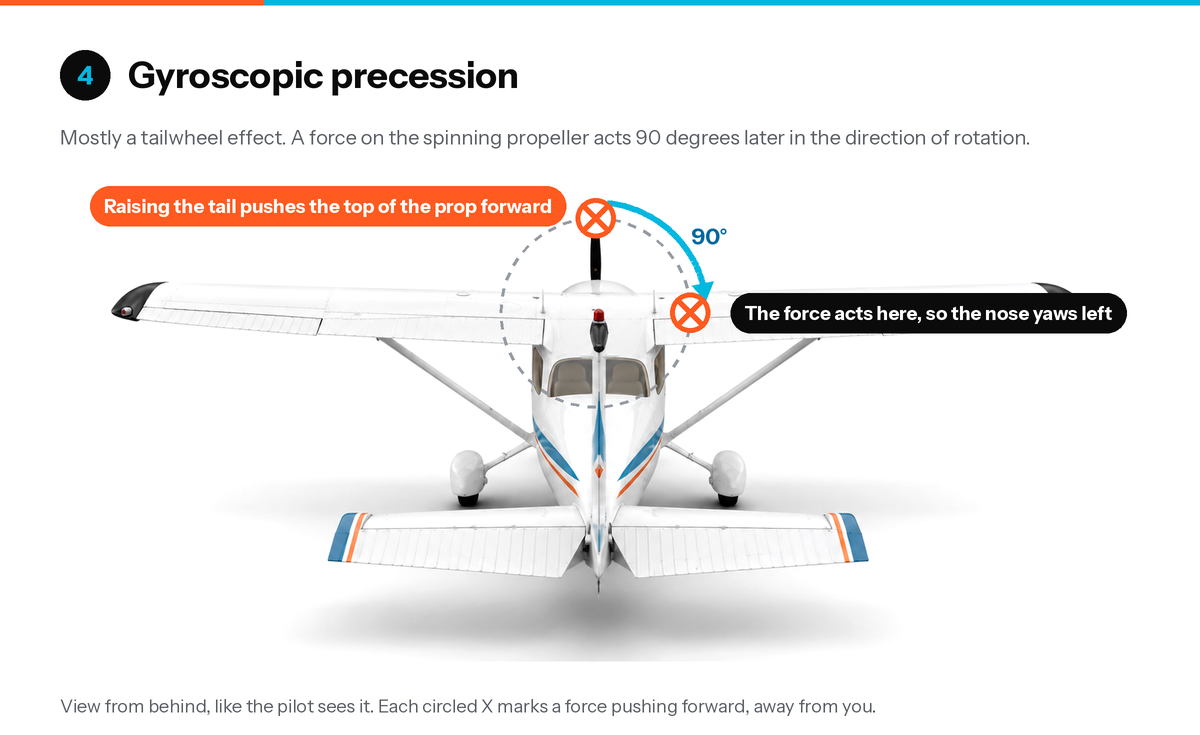
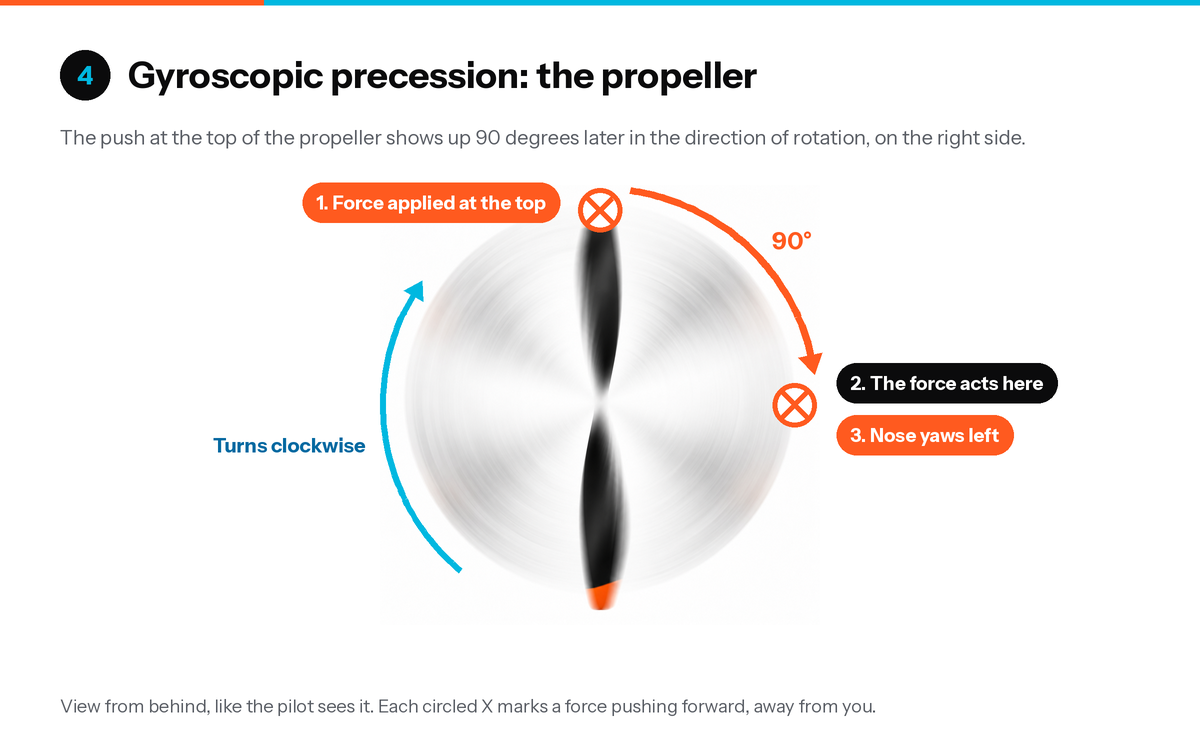
A spinning propeller acts like a gyroscope. When a force is applied to it, the result happens 90 degrees later in the direction of rotation. This matters most in tailwheel airplanes. When you raise the tail on the takeoff roll, it is like pushing forward on the top of the propeller. That force shows up 90 degrees later on the right side, and the nose yaws to the left.
Airplane designers offset some of these tendencies for cruise flight, using things like an engine that is angled slightly to the right and trim tabs. Those fixes only work well at one power setting and airspeed, so at high power and low airspeed, the correction is your right rudder.
2. Adverse yaw
Adverse yaw is the tendency of the nose to yaw away from the direction of the turn when you roll in with aileron. It happens in four steps.
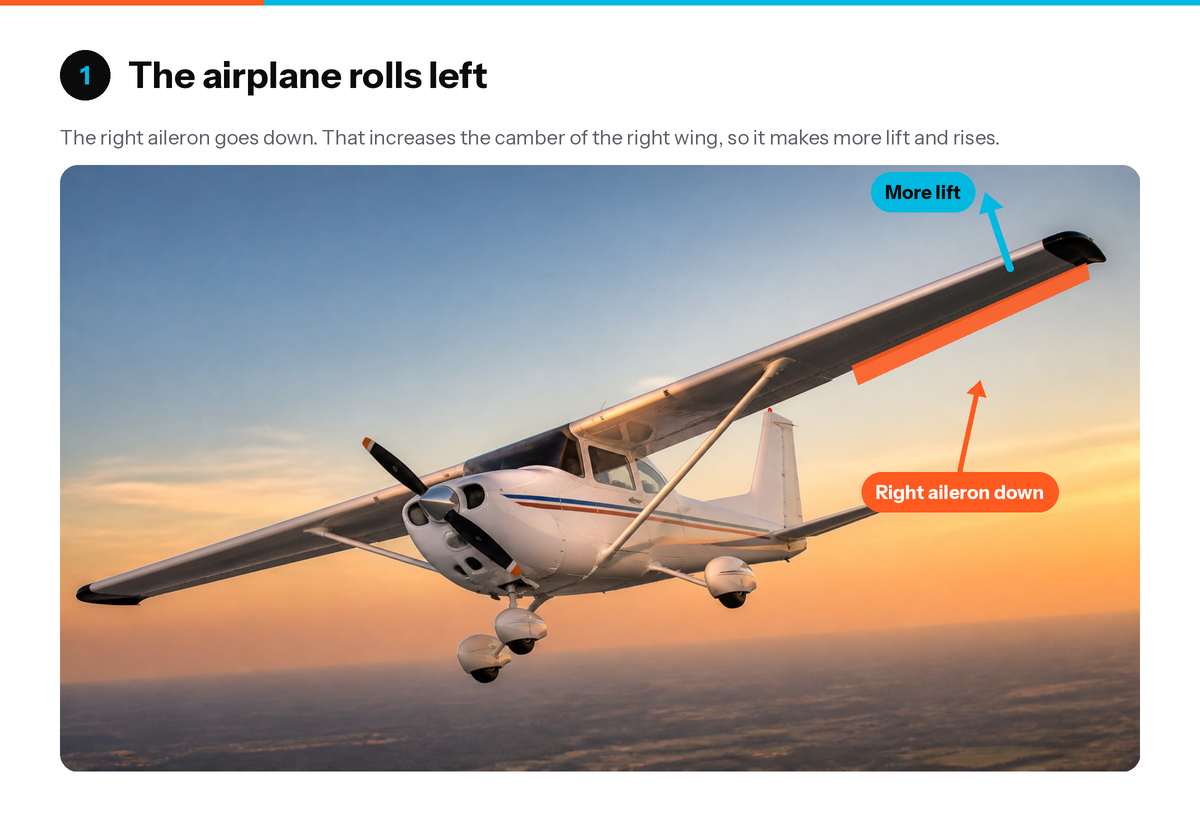
Step 1: The airplane rolls left
To roll left, you turn the yoke to the left. The right aileron goes down and the left aileron goes up. The lowered right aileron increases the camber of the right wing, so the right wing makes more lift and rises.
Step 2: More lift means more induced drag
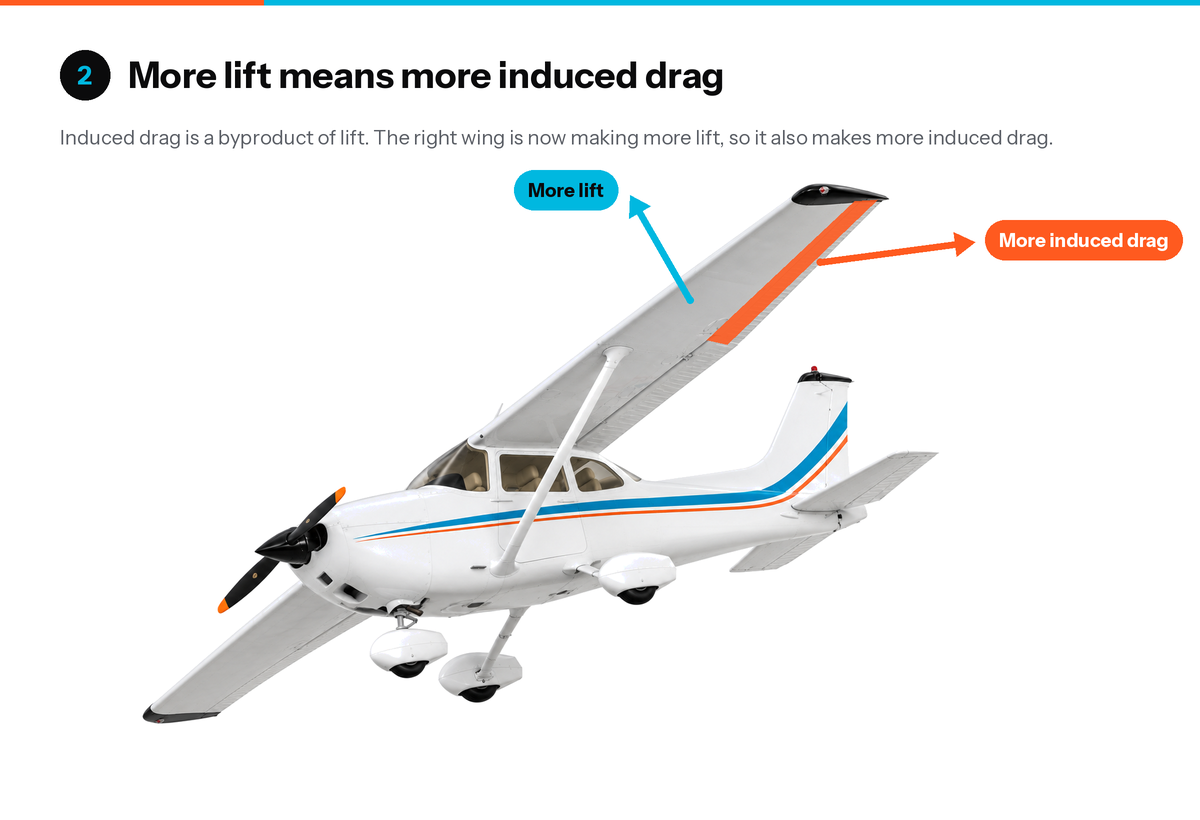
Induced drag is a byproduct of lift. Because the right wing is now making more lift, it also makes more induced drag. The left wing, with its aileron up, makes less lift and less induced drag.
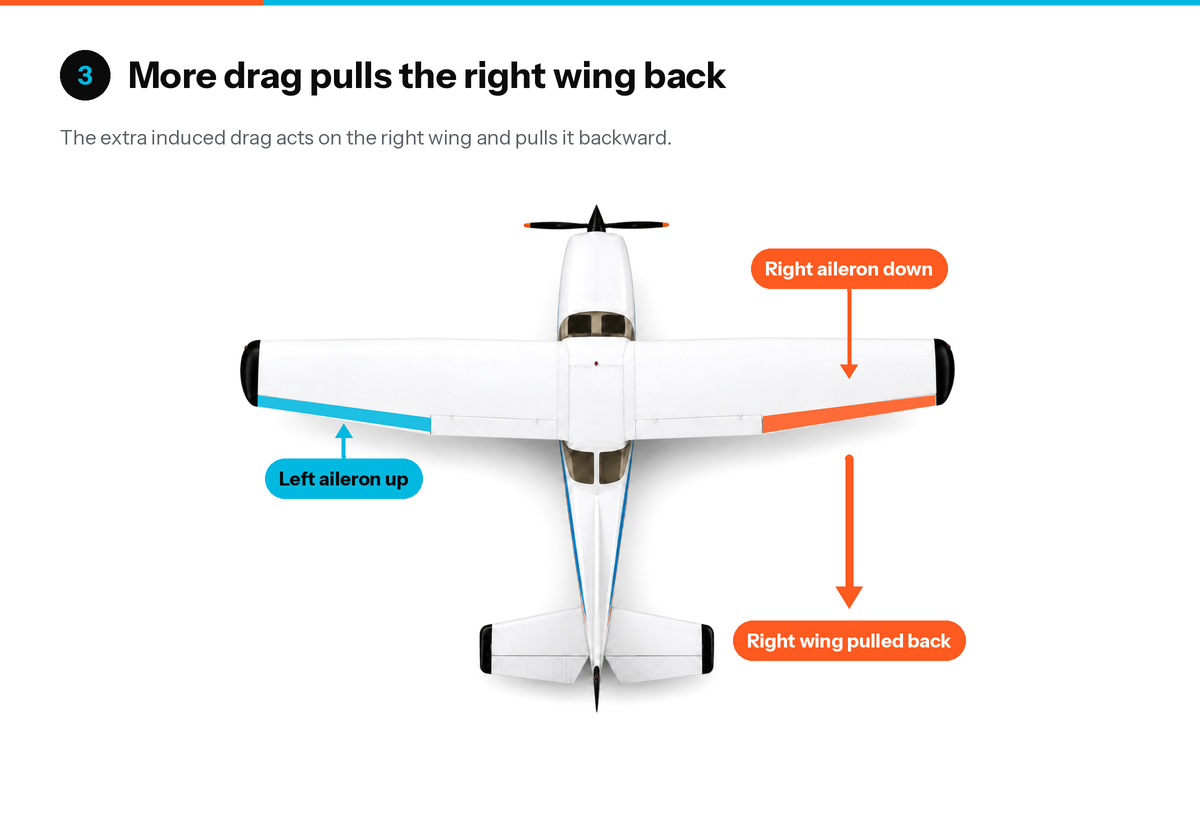
Step 3: More drag pulls the right wing back
The extra induced drag acts on the right wing and pulls it backward.
Step 4: The nose yaws opposite the turn
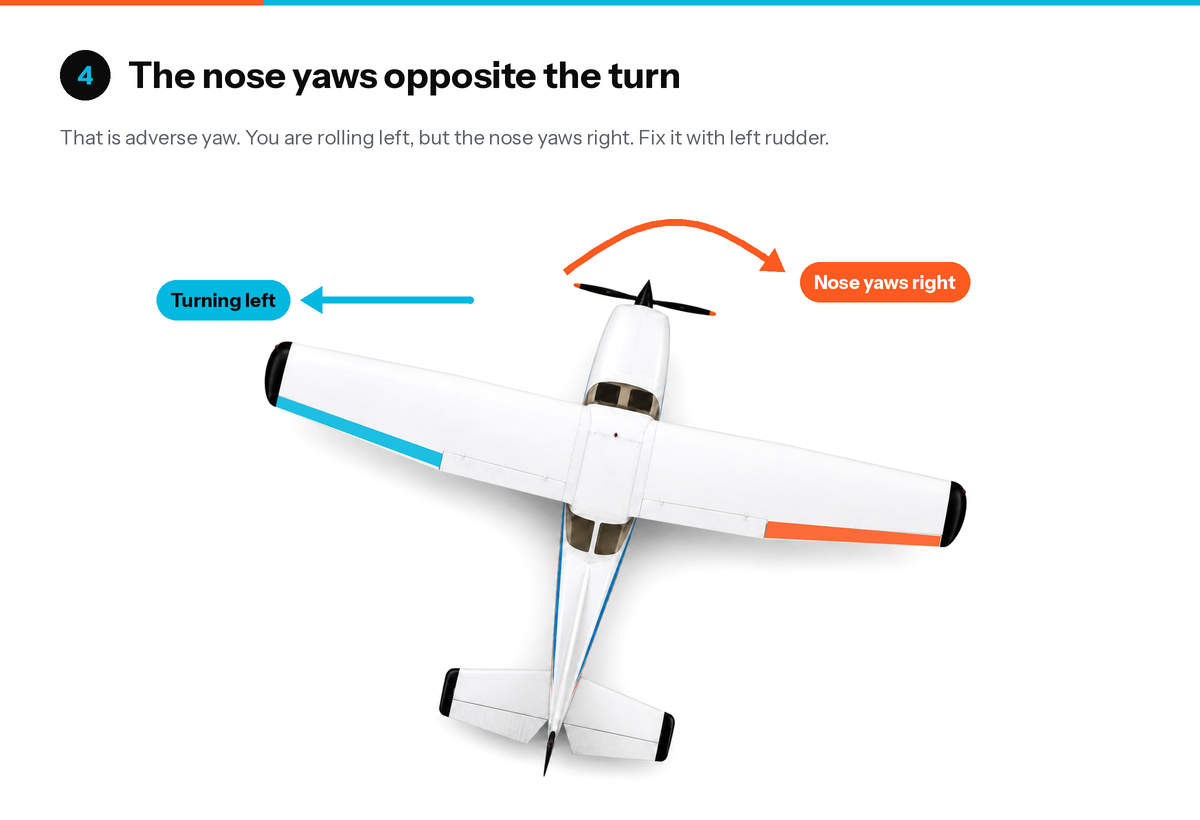
When the right wing is pulled back, the nose yaws to the right, even though you are rolling to the left. That is adverse yaw: the nose yaws in the opposite direction of the turn.
How to correct it
The fix is rudder in the same direction as the turn. When you roll left, add left rudder. When you roll right, add right rudder. Watch the ball in the turn coordinator and step on the ball to keep it centered. Adverse yaw is strongest at low airspeed with large aileron inputs, so you will feel it most in slow flight and in the traffic pattern.
Designers reduce adverse yaw with differential ailerons, where the up aileron travels farther than the down aileron, and with Frise-type ailerons, where the up aileron pokes its leading edge into the airflow to create drag on the descending wing. Neither one gets rid of it completely, so coordination is still your job.
3. Static stability
Stability is the airplane's ability to correct for conditions that disturb it, like turbulence or a control input. Static stability is the airplane's initial tendency after it has been disturbed. There are three kinds:
- Positive static stability: the initial tendency is to return to its original attitude.
- Neutral static stability: the initial tendency is to stay in its new attitude.
- Negative static stability: the initial tendency is to keep moving away from its original attitude.
Training airplanes are designed with positive static stability, so they tend to return to where they were after a bump.
4. Dynamic stability
Dynamic stability is what the airplane does over time after it is disturbed. As it tries to return to its original attitude, it usually overshoots and oscillates.
That means the airplane must have positive static stability to have any type of dynamic stability. With neutral or negative static stability, the airplane never starts back toward its original attitude, so it never overshoots, and there are no oscillations to measure. Dynamic stability describes what happens after positive static stability starts the airplane on its way back.
What those oscillations do over time is its dynamic stability:
- Positive dynamic stability: the oscillations get smaller over time until the airplane settles.
- Neutral dynamic stability: the oscillations stay the same size.
- Negative dynamic stability: the oscillations get bigger over time.
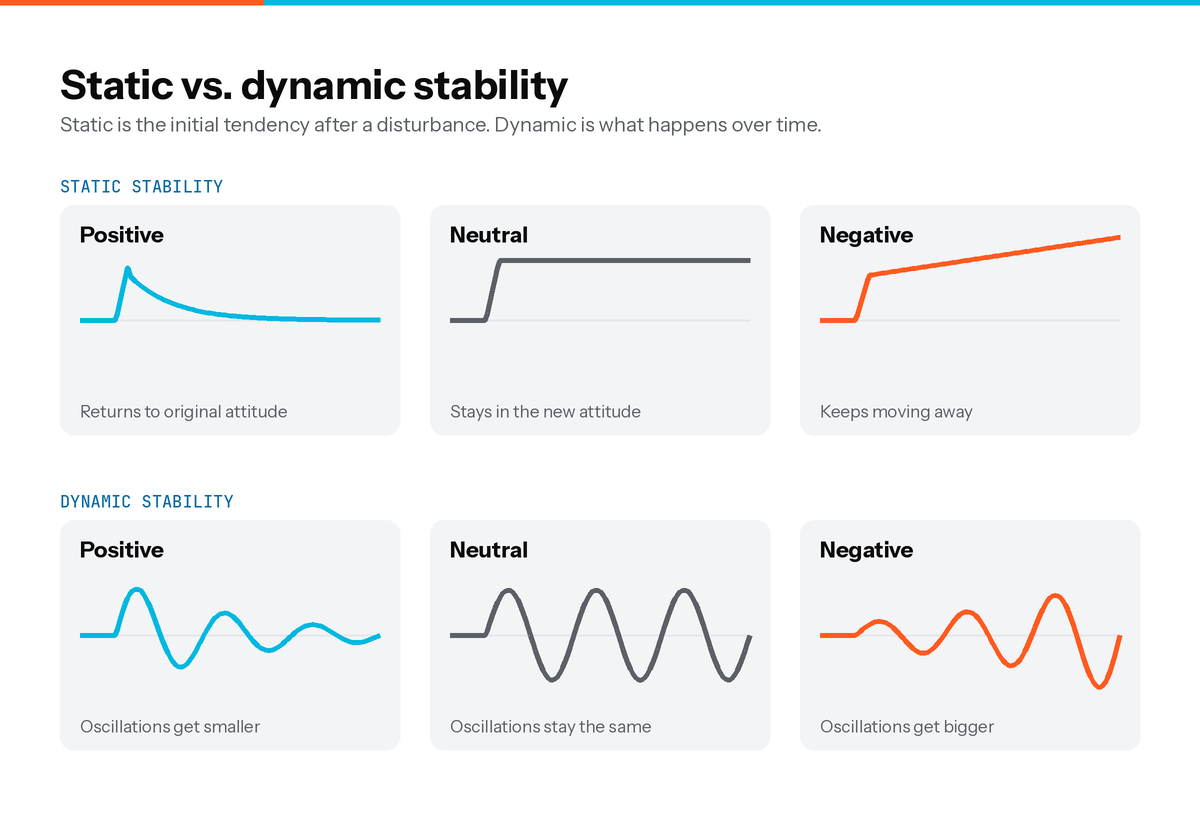
Here is the part students miss. An airplane can have positive static stability and still have negative dynamic stability. It starts back toward its original attitude, but each overshoot gets bigger. Positive static stability is required for dynamic stability, but it does not guarantee positive dynamic stability. Your DPE may give you a scenario like that and ask you to name both.
Stability around each axis
Longitudinal stability is stability in pitch, around the lateral axis. The center of gravity is ahead of the center of lift, so the airplane naturally wants to pitch nose down, and the horizontal tail balances that with a downward force. If the nose pitches down, airspeed increases, the tail down force increases, and the nose comes back up. Where the CG sits changes this. A forward CG makes the airplane more stable but raises the stall speed and makes the elevator heavier. An aft CG makes it less stable, lightens the controls, and makes stall and spin recovery more difficult.
Lateral stability is stability in roll, around the longitudinal axis. It comes mainly from dihedral, the upward angle of the wings. When one wing drops, the airplane slips toward the low wing, and the low wing meets the air at a greater angle of attack, makes more lift, and rolls the airplane back toward level.
Directional stability is stability in yaw, around the vertical axis. It comes mainly from the vertical stabilizer and the side area of the fuselage behind the CG. Like a weathervane, the tail keeps the nose pointed into the relative wind.
Mock checkride questions
Try answering each one out loud before you read the passing answer.
Keep studying
Turning tendencies, adverse yaw, and stability tie into almost everything else in aerodynamics, from stalls and spins to weight and balance. If you can explain the why behind each one, you are ready for anything your DPE asks.
Always verify against the current FAA handbooks and confirm with your flight instructor before your checkride.